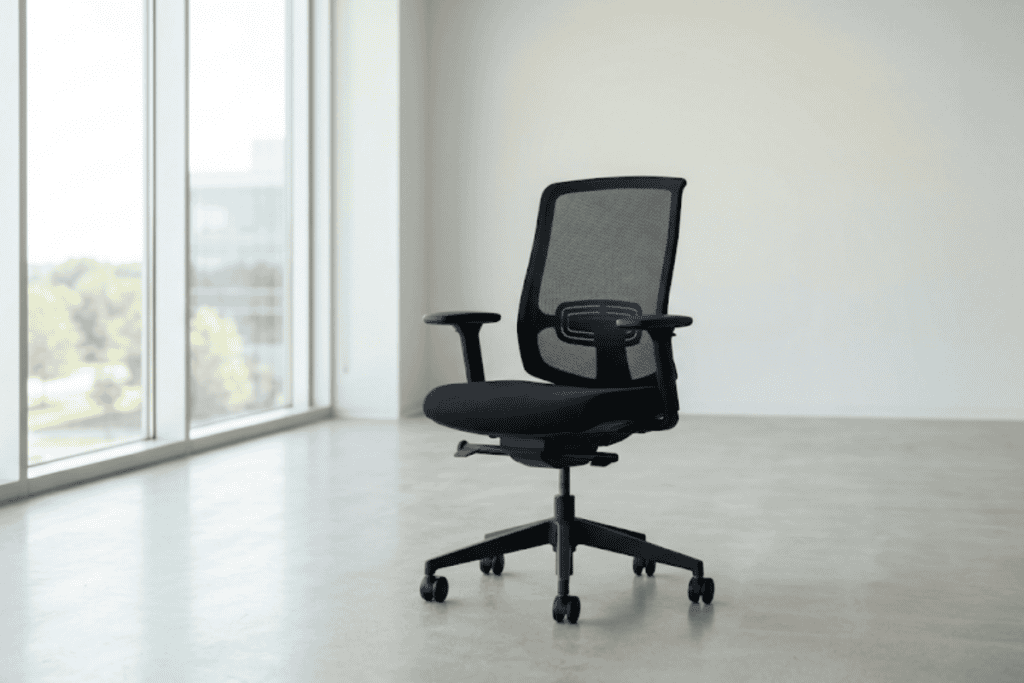
Most office managers assume a chair is still fine as long as it isn’t visibly broken, but that assumption is usually wrong long before a wheel falls off or an armrest cracks. In reality, how long do office chairs usually last before replacing them comes down to a fairly predictable range: most quality office chairs last between 5 and 10 years under standard daily use, and the parts most likely to fail first, foam padding and gas lift cylinders, often wear out quietly while the chair still looks perfectly presentable.
That gap between “looks fine” and “still supports you properly” is where most Broken Arrow offices get caught off guard, either replacing chairs too early out of caution or holding onto them years past the point where they’re doing an employee’s back any favors.
What actually determines a chair’s lifespan
A chair’s expected life depends heavily on its build quality and how it’s used. Commercial-grade chairs tested to industry seating standards are built for roughly eight hours a day, five days a week, and typically last 7 to 8 years under that standard use, sometimes stretching to 10 to 15 years for higher-end models with heavier-duty components. Budget chairs without that level of testing often show comfort and support loss within just 1 to 3 years, even if the frame itself survives longer.
The three failure stages
Chair lifespan does not fail all at once. Ergonomic support, meaning the foam and lumbar padding, is usually the first thing to go, often fading within 2 to 4 years even though the chair still looks new. Mechanical parts like the gas cylinder, tilt mechanism, and casters typically follow at the 5 to 8 year mark. The frame and outer fabric or mesh can hold up cosmetically for 7 to 10 years or longer, which is exactly why a chair can look completely fine while its actual support has already failed.
| Chair Type | Typical Lifespan | First to Wear Out |
|---|---|---|
| Budget task chair | 1 to 3 years | Seat foam and comfort |
| Commercial-grade task chair | 7 to 8 years | Gas cylinder, casters |
| High-end executive chair | 10 to 15 years | Upholstery wear |
The table mirrors what’s described above: budget chairs lose comfort first and fastest, commercial-grade chairs hold up for 7 to 8 years before mechanical parts go, and high-end chairs can stretch well past a decade before it’s time to replace them.
Signs it’s time to replace, not repair
- The seat sinks slowly throughout the day or won’t hold height at all, usually a failed gas cylinder
- Casters stick, wobble, or no longer glide smoothly across the floor
- Fabric or mesh is visibly torn, or padding has flattened enough that you can feel the frame underneath
- An employee reports new or worsening back, neck, or shoulder discomfort tied to sitting
- The chair is more than 7 to 8 years old and showing two or more of the issues above at once
Why Choose Sundance Office
We don’t guess at what your office needs, we plan for it. Our furniture team offers free space planning and installation for Broken Arrow and Tulsa area businesses, which means when it’s time to replace a batch of chairs, we’re looking at your actual layout, usage patterns, and budget rather than just swapping in whatever’s on the showroom floor. Because we carry chairs across a range of price points and warranty lengths, we can match the chair to the job, a heavier-duty option for a shared reception desk that sees constant turnover, versus a standard task chair for a private office used by one person.
Most office chairs will tell you they need replacing well before they fully break, if you know what to look for. The plain rule of thumb for any Broken Arrow office is to treat a chair’s warranty length as a rough guide, not a guarantee, and start paying closer attention once it passes the 5 to 7 year mark, since that’s when mechanical failures and ergonomic complaints tend to show up together. If a handful of chairs in your office are hitting that window at the same time, it’s worth budgeting for a batch replacement of furniture rather than replacing them one at a time as each one fails.
Wondering if your office chairs are due for a refresh? Contact our furniture team for a quick walkthrough of your space.
Frequently Asked Questions
How do I know if my office chair needs replacing?
Watch for a seat that sinks or won’t hold height, casters that stick or wobble, visibly torn fabric or flattened padding, and any new back or neck discomfort tied to sitting, especially once the chair is past 5 to 7 years old.
Can a worn office chair cause back pain?
Yes. As foam padding and lumbar support break down, the chair stops holding a neutral sitting posture, which forces muscles to work harder to compensate and can lead to new or worsening back and neck discomfort over time.
Is it cheaper to repair or replace an office chair?
For a high-end chair with only one worn part, like the gas cylinder or casters, repair is usually cheaper. Once a chair is showing multiple issues or is past 7 to 8 years old, replacement is typically more cost-effective than repeated repairs.
How long does a mesh office chair last compared to a fabric chair?
Both typically fall in the same 5 to 10 year range, though mesh tends to show visible wear, like stretching or sagging, sooner than tightly woven fabric, even if the underlying mechanism is still in good shape.
Do more expensive office chairs really last longer?
Generally, yes. Higher-end chairs use more durable materials and mechanisms built to withstand more testing cycles, which is why they often come with longer warranties and can last 10 to 15 years compared to 5 to 8 years for standard models.