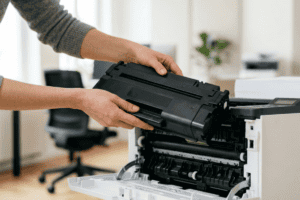

When your printer says paper jam but there is no paper stuck, it feels like the machine is playing games with you. You open every tray, peer inside, tug at rollers, and find absolutely nothing, yet the error will not clear. This is one of the most common printer complaints we hear from busy offices across Broken Arrow and the Tulsa metro, and there is almost always a logical explanation. A jam error is not proof that a sheet is wedged somewhere. It is proof that a sensor in the paper path believes something is wrong. Once you understand that difference, clearing the error becomes far less mysterious.
Why Your Printer Says Paper Jam But There Is No Paper Stuck
Printers do not see paper the way you do. They rely on a series of small mechanical flags and optical sensors positioned along the paper path. As a sheet travels through, it flips these sensors in a precise sequence and timing. If a sensor stays triggered when it should be clear, gets stuck, or is fooled by a tiny scrap of paper, the printer reports a jam even though the main sheet has long since passed or was never there. University IT teams that manage large printer fleets document exactly this pattern, noting that jam errors trace back to the paper path rather than a single obvious blockage. Penn Carey Law’s guide to printer jams walks through tracing that path, and BYU’s print team explains how the same fault can surface under several different error codes.
The Usual Hiding Spots for a Phantom Jam
The most frequent culprit is a torn fragment of paper, often no bigger than a fingernail, hiding under a roller or against a sensor. University of Illinois Library staff specifically advise checking for and gently removing paper fragments and not overfilling trays, because both cause repeat errors. The next suspect is the set of pickup rollers, which grip and pull each sheet. When they wear smooth or collect dust, they slip and misfeed, and the printer interprets the mistiming as a jam. Dust or a stuck sensor flag, a slightly open cover, and curled or damp paper round out the usual list. A broader printer troubleshooting resource from William and Mary IT covers these same failure points across different models.
Step by Step: Clearing a Phantom Paper Jam
Work through the paper path methodically rather than yanking at random. The table below pairs the common hiding spots with what to check and how to clear each one.
| Where Phantom Jams Hide | What To Check | How To Clear It |
|---|---|---|
| Torn paper fragment | A small scrap left behind is tripping the sensor | Open all covers and remove every scrap along the paper path |
| Dusty or stuck sensor | The jam sensor or flag is blocked or dirty | Power off and gently clean the sensor area with dry air |
| Worn pickup rollers | Rollers slip and misfeed, which reads as a jam | Clean or replace the pickup rollers |
| Overfilled or wrong paper | The tray is too full or the paper is curled or damp | Reload a smaller, flat stack of the correct size |
| Software or memory glitch | A stalled job leaves a false error on screen | Power cycle the printer and clear the print queue |
As the table shows, a torn paper fragment tripping the sensor is cleared by opening all the covers and removing every scrap along the paper path. A dusty or stuck sensor is cleared by powering off and gently cleaning the sensor area with dry air. Worn pickup rollers that slip and misfeed should be cleaned or replaced. An overfilled tray or curled, damp paper is fixed by reloading a smaller, flat stack of the correct size. And a software or memory glitch that leaves a false error is cleared by power cycling the printer and clearing the print queue. If you want a quick reset routine to run first, follow these steps.
- Turn the printer off, unplug it for about 30 seconds, then plug it back in and power up.
- Open every access door and tray, and remove any paper, then close them firmly.
- Pull the paper tray out completely, fan the stack, and reload it flat and squared.
- Clear any pending jobs from the print queue on your computer.
- Print a single test page before sending a large job.
When To Call a Technician
If you have cleared the paper path, cleaned the sensors, reloaded fresh paper, and power cycled the machine, but the jam error keeps returning, the issue is likely a worn roller, a failing sensor, or a mechanical fault that needs hands on service. Repeated phantom jams waste paper, time, and patience, and they tend to get worse, not better. A certified technician can test the sensors and rollers directly and replace the specific worn part, which is almost always cheaper than living with daily downtime or buying a new printer. Professional printer repair is the right move once the simple fixes stop working, and stocking the correct, flat, dry paper from the start prevents many jams before they begin.
Why Choose Sundance Office
Sundance Office keeps offices across Broken Arrow, Tulsa, Oklahoma City, and the surrounding area printing smoothly, and stubborn jam errors are squarely in our wheelhouse. Our certified technicians diagnose the real cause instead of guessing, whether that is a slipping roller, a dirty sensor, or a failing feed assembly, and we carry the parts to fix it fast. We also supply quality paper and consumables that feed cleanly, since cheap, curled, or humid stock is behind a surprising number of jams. Keeping the right paper on hand is part of a well stocked office, and our guide to essential office supplies is a helpful starting point. Choosing a local partner means quick response times and technicians who actually know your equipment.
Conclusion
A printer that says paper jam but there is no paper stuck is almost always reacting to a tripped sensor, a hidden fragment, a worn roller, or a software hiccup, not a sheet you simply cannot find. Work the paper path in order, clear every scrap, reload flat paper, and power cycle the machine, and most phantom jams disappear. When the error keeps coming back, that is your cue to bring in a technician before it costs you a full day of productivity. For dependable service and consumables that feed cleanly, the team at Sundance Office is ready to help your Broken Arrow or Tulsa office get back to work.
Tired of chasing jams that are not there? Contact Sundance Office to schedule expert printer service today.
Frequently Asked Questions
Why does my printer say paper jam when there is no paper?
A jam message means a sensor in the paper path is being triggered, not necessarily that a full sheet is stuck. A tiny torn fragment, a dusty sensor flag, a worn roller, or a software glitch can all cause the error with no visible paper.
How do I fix a paper jam error when there is no paper stuck?
Open every cover and tray and remove any small scraps along the entire paper path, then gently clean the sensor areas. Reload a flat, correctly sized stack and power cycle the printer to reset the sensors.
How do I reset my printer to clear a false paper jam?
Turn the printer off, unplug it for about 30 seconds, then plug it back in and power it on. This clears the printer’s memory and often resets a stuck sensor that was reporting a false jam.
Where is the paper sensor located in a printer?
Most printers have several sensors spaced along the paper path, typically near the pickup rollers, the fuser area, and the output tray. They are small optical or mechanical flags that detect a sheet as it moves through each stage.
What causes a ghost (phantom) paper jam?
Phantom jams are usually caused by a small paper fragment, a dirty or stuck sensor, worn pickup rollers that misfeed, or a stalled print job in memory. Because no full sheet is visible, the fix is cleaning the path and sensors and power cycling the machine.